Czech Center New York presents the exhibition Amicable Separation, which is a dialogue between the themes and stories of Czech and Slovak artists currently based in New York, organized to mark the 30th anniversary of the independence of the two countries after the division of Czechoslovakia. Curated by Charlotta Kotik.
The exhibition Amicable Separation is a dialogue between the themes and stories of Czech and Slovak artists, organized to mark the 30th anniversary of the independence of the two countries after the division of Czechoslovakia. The project, curated by Charlotta Kotik, highlights the positive cooperation between Czechs and Slovaks and the ongoing cultural exchange between two nations, which has actively developed despite the separation and independence of the Czech Republic and Slovakia. Today, both Czech and Slovak artists are achieving recognition on the world stage and have become an integral part of the global art world. New York is currently hosting a number of artists from both countries who have been awarded residencies, prestigious fellowships, or are currently exhibiting in local galleries. The Czech Center New York connects these artists and provides a platform for them to present their aesthetics, working methods and newly created artworks.
Exhibiting artists: Radek Brousil (SK/CZ), Kristyna and Marek Milde (CZ), Tamara Moyzes / Romane Kale Panthera (SK/CZ), Gregor Petrikovic (SK), Ezra Šimek (CZ), Adam Vačkář (CZ), Martin Vongrej (SK)
Opening Reception: Thursday, September 7th, 2023, 6 PM – 8 PM. Free registration here.
It is not given that the division of an existing entity into two separate units is done in a rational and amicable manner, whether it is on the level of personal relationships or as in relations between neighboring states. An exception in the geo-political sphere was the peaceful division of Czechoslovakia into the Czech and Slovak Republics in 1993, shortly after the Velvet Revolution.
Czechoslovakia, founded in 1918 on modern democratic principles, went through the difficult years of the Second World War and later Communist dictatorship. Culture played an essential role during this difficult period; it was the arts that helped to establish the democratic traditions of the interwar republic and to maintain them during the period of totalitarianism.
In spite of the break-up, or thanks to the independence of the Czech Republic and Slovakia, the positive cooperation between these now independent partners has been strengthened and continues to actively develop. Over the last 30 years, Czech and Slovak artists have gained greater access to global artistic platforms and the freedom to create work based on the specific cultural environment and needs of both countries. Nowadays, Czech and Slovak artists have achieved world recognition and become an integral part of the global artworld.
During the summer and autumn of 2023, a number of artists from both countries are working in New York, having been awarded artist residencies, prestigious scholarships, or are currently exhibiting in local galleries. The Czech Center in New York, in this project, provides a platform for the presentation of aesthetics, working methods and new artworks.
In their works the artists are addressing important issues of our current world - they comment on the present socio-political discord, they illuminate the growing awarness of gender identity, class and religious antagonisms as well as
the economic inequity. Many are pointing out the issues of ecological destruction and the impending catastrophe. They are equally involved in research of new materials and technologies thus enriching already accepted art disciplines and methods through the contemporary experience.
Radek Brousil is an interdisciplinary artist who uses textile, ceramics, photography, video and film, to create unique installations. He presently shows a predilection for painting, while still keeping an unorthodox approach to the medium, combining paint with photo transfer on unstretched canvas.
The work of Kristyna and Marek Milde, Czech artists living in Brooklyn, deals with themes of the natural environment. Their project, Motherboards, 2023, explores the tension between culture and nature in urban setting based on photographs of wires and power lines that intertwine with tree branches. Its patterns are created by etching and electroplating techniques used for printing circuit boards.
Tamara Moyzes is a politically motivated artist who probes various media to comment on the pressing topics of gender, identity, racism and ever-increasing intolerance. She is also a curator and theorist who uses exhibitions and performances to bring attention to societal ills. By focusing on individual events she sharpens our attention to the shortcomings of the present world order and motivates us to look for better solutions.
Gregor Petrikovic is a performance artist who considers movement his prime medium. He frequently participates in his works as a lead actor as well as directs the casts he assembles. Petrikovic documents the performances he stages using 16mm films . Well versed in philosophy and history of art he often alludes to the famous art works or the philosophical concepts of the past.
Ezra Šimek explores queer identities and linguistic sensitivity through use of time based media such as films, performances, lectures and writing, while also creating site specific installations. They explore various societal identity constructs and through speculative narratives, that often explore the power of fable, they bring magical elements into their work. All in the hope that the society as a whole will become more understanding, tolerant and inclusive.
Themes of nature and the environment are explored by other artists in a variety of ways. Adam Vačkář brings the results of his collaboration with biologists and natural science experts into the concept of his works, pointing out our-not-always sensitive coexistence with the environment.
Martin Vongrej is an artist of gentle gestures. He teases our ability to perceive minute details, often residue of an accidental touch of the material, and to consider them to be of primary importance. Often philosophical, always minimalist and conceptual in its core, Vongrej’s work requires acute visual concentration.
The exhibition Amicable Separation is an open dialogue between themes and stories of Czech and Slovak artists, becoming a contribution to the celebration of 30 years of independence of the two countries and emphasizing that separation (whatever it may be) can bring positive results.
Photogallery:
1. Radek Brousil: From the series Someone found the future as a statue in a fountain - 40 x 32 inches/100 x 80 cm, oil on linen, qouache, photo transfer, spray paint, charcoal, 2023
2. Kristyna and Marek Milde: Motherboards, 2023, edition of 5, Photo Etching on Printed Circuit Board (PCB) with immersion gold finish, 21.6”x 14.3” (55cm x 36.4cm) each
3. Martin Vongrej: Untitled, 2023, Detail, Chalk and Cord on Mdf, 24 ½ x 23 ½ in.
4. Tamara Moysez / Romane Kale Panthera: From a performance "Father of the Nation, We Have Let Stanislav Tomáš down!" Photo credit: Petr Zewlakk Vrabec
5. Ezra Šimek, Bodie, 2022, HD video, 7:40 min. Courtesy of Ezra Šimek
6. Gregor Petrikovic: A film still from Figura Serpentinata (Digitised 16 mm film, 4:05)
Born from ideas that Charlotta Kotik discussed with Prague based art critic, Lenka Lindaurová, this presentation develops the idea of a dialogue between Czech and Slovak artists, curators as well as institutions, and may be the beginning of a deeper collaboration on a larger exhibition in the near future.
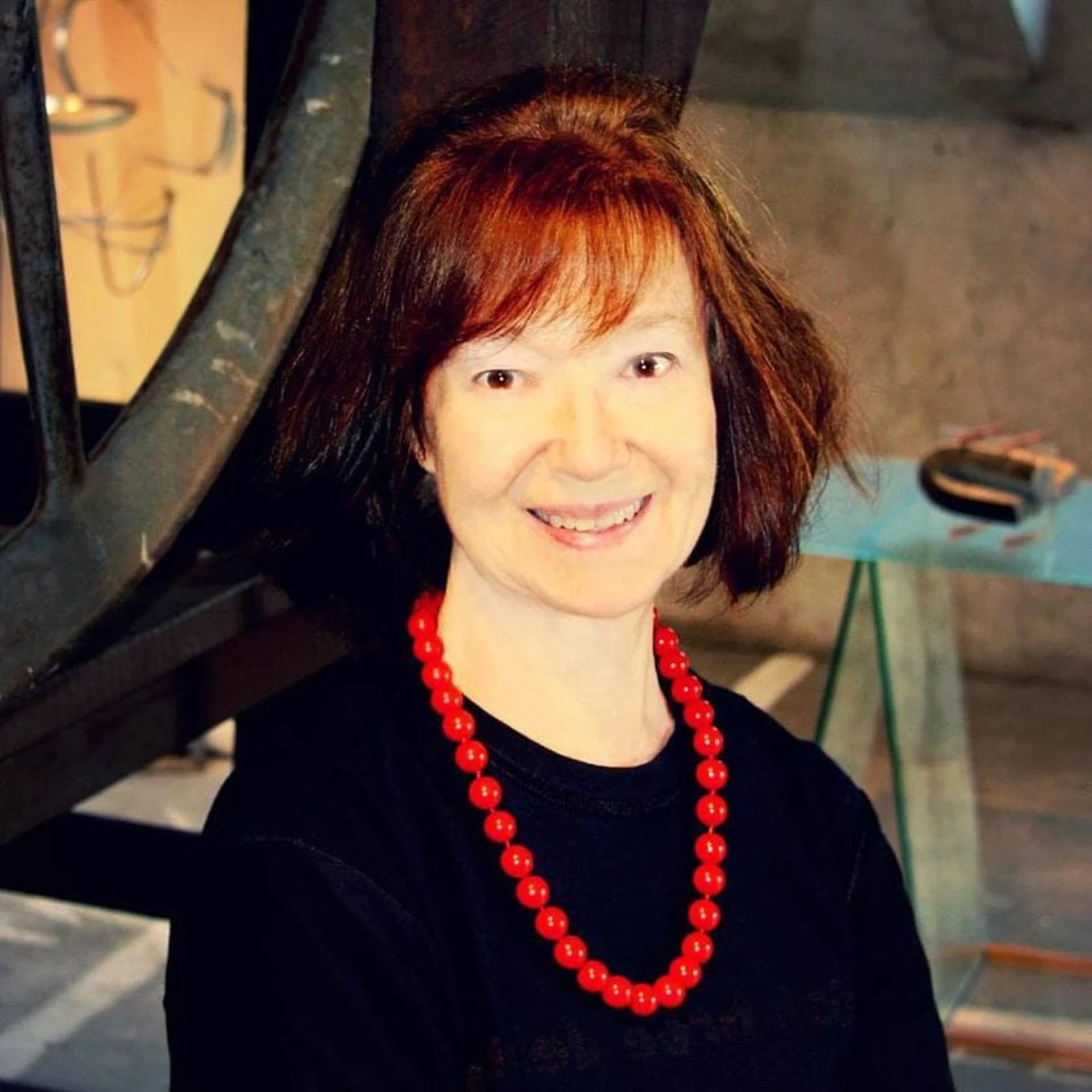
Photograph: Charlotta Kotik
The event organizer has the right to refuse the attendees' entrance to the venue despite previous registration due to capacity and security measures. Participants must arrive on time; in case of late arrival, the organizer cannot guarantee that your registration will remain valid.
By attending an event hosted by the Czech Center New York you are entering an area where photography, audio and video recording may occur. By attending the event, you agree that the Czech Center New York and its partners may use these materials.
You waive and release any claims you may have related to the use of recorded media of you at the event, including, without limitation, any right to inspect or approve the photo, video or audio recording of you, any claims for invasion of privacy, violation of the right of publicity, defamation, and copyright infringement or for any fees for use of such record media.