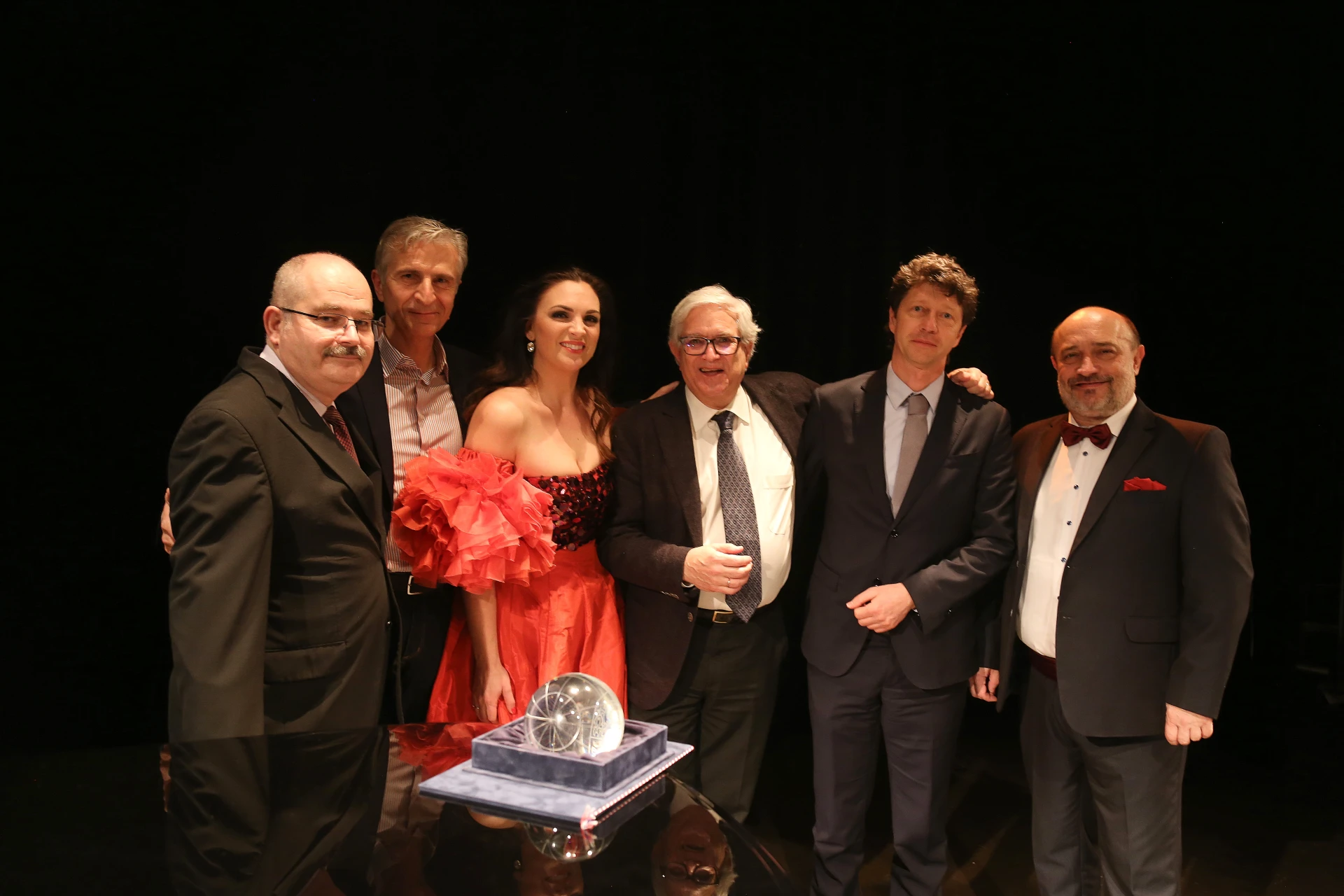
American musicologist, professor Michael Beckerman received Gratias Agit Award in New York from the representatives of Ministry of Foreign Affairs of the Czech Republic for his long-standing support of the Czech culture, Czech music and the Czech music composers in the US.
The lifelong passion of Professor Michael Brim Beckerman has been a true blessing for the Czech music and musicology scene. His caring yet critical approach towards classical music written and performed in the past half-millenium by musicians and composers from what is today Bohemia and Moravia, is inspiring both in its professional merit and in its innovative and often provocative methodological approaches towards the subject matter at hand, which until recently was often discussed almost exclusively in a positive light. Beckerman's scope ranges from strictly academic publications to brilliantly formulated popular articles in the New York Times. His conference on Janáček and Czech music, which he organized in 1988 at Washington University in St. Louis, has already become a matter of legend — he had invited musicologists from five countries to the event, including from what was then Czechoslovakia, and for many of them, it was their first-ever encounter with the American musicology scene. As an excellent musician and pianist, Beckerman was able to combine his deep understanding of Czech music with brilliant theoretical reflection. For decades, he has educated countless musicologists at Washington University in St. Louis, UC Santa Barbara, and NYU, opening the door for many of them to Czech music. It would, of course, be wrong of us to reduce his contributions to musicology to just Czech music, but it's quite clear that it's precisely Czech music in which he has left his deepest mark in the past half-century. I look forward to every new text Michael Brim Beckerman brings and to every new passionate debate he will most certainly incite.
Interview with prof. Michael Beckerman:
·If you were to list a couple of reasons why the classical European music and Czech music especially are still so appreciated in the US, what are these reasons?
There are several "Czech musics." One of them is simply the sum total of all works written by composers who identify as Czech. But another is a more select group of works that are thought of as somehow "sounding Czech" in the ears of audiences, and these make up a goodly proportion of works performed in this country. And these latter works are valued by audiences because, although they stem from the same fundamental source as the core repertoire of Bach, Mozart, Haydn, Beethoven, Schubert, Schumann, Brahms, etc., they also showcase a different aesthetic which audiences find compelling.
·Tell us how you came to love Czech music so deeply and be interested about Czech composers?
From a fairly early age I loved Dvorak's chamber music, but it was not until I went to work in a record store around 1973 that I was broadly exposed to Czech music. One of the sales people from Supraphon Records approached me with a problem. He had, he said, all these fantastic recordings, but no one could pronounce the names of the composers and no one knew the repertoire. Would I, in exchange for free recordings each month, listen and learn, and if I like particular recordings, try to sell them to my customers. So that began my "romance" with Martinů and Mysliveček, Suk and Novák, and many more composers. By the time I got to graduate school a year later--originally intending to study Mozart--I had become, at least according to my classmates though not in my own mind, an "expert" in Czech music. As they say, all it takes is a little knowledge to know how much there is to know.
·In your opinion: are there any visible trends in popularity of compositional styles and composers that are now more appreciated than before?
I'm not sure how much reshuffling there has been over the last two decades or so. I suppose the most notable shift in my lifetime was the increasing popularity of Janacek, almost unknown in this country in the 1950's, and whose chamber, orchestral and operatic works have become part of the repertory. I have hopes that composers such as Kapralova, Suk, Novak, Fibich, Jezek and many others will gain some position in the repertory, and that the quality and traditions of Czech music will be respected and treasured.
·Let's look to the Czech contemporary music scene: Is the music difficult to reach a wider audience? For instance, would you agree there are no contemporary Czech composers who are successful in having their music performed by major opera houses in the US?
Considering, and no disrespect meant to them, that most audiences go to concerts to be entertained, and a great deal of contemporary music requires a good degree of patience and acclimation, the relationship between new music and audiences can be problematic. I mean, not only is a piece heard for the first time something like an experiment, asking the question, "is it worthy of our time" (something not usually asked of, say, a Beethoven string quartet), but often the idioms of new music can be challenging. That's one reason why perhaps the most popular style of new music is, loosely speaking, minimalism. We can add to this the fact that "modern music," if by that we mean compositions which depart from traditional tonal schemes, is already more than a century old. So the good news is that there are many wonderful composers whose works could and should be introduced to American audiences, figures such as Ivana Loudova, Viktor Kalabis, Petr Eben, Milos Stedron, Jindrich Feld, and the list goes on. Whether there are Czech contemporary operas that could or will appear at the Metropolitan Opera or other large houses in New York is an open question, but I saw a fascinating production of Mirek Srnka's "South Pole," at the Staatsoper Munich, and Ales Brezina's "political" chamber opera Zitra se bude/Tomorrow the People Will Be, is a deeply moving production.
·What can the Czech cultural institutions and artists do to have more visibility in the US and worldwide, extending beyond the traditional Czech musical giants of there past?
That's a difficult question. I suppose it probably requires some combination of "home court" and "away court." By that I mean that it is vitally important for Czech organizations in the United States and elsewhere to nurture and encourage new artistic creations, and provide a "safe harbor" where performers and composers feel comfortable. So, concerts, or other kinds of artistic events, featuring entirely new Czech repertory, will play a role in the process. But it's also important to try to get pieces by Czech artists programmed in concerts and events outside of the Czech sphere, to coexist and even "compete" with other works. I believe it is the same for those trying to advance research on Czech music. Having specialized publications is all well and good, but we must also try to place our works in elite international journals and presses. In the end, we are lucky to have the Bohemian National Hall and Czech Centers worldwide as our "safe harbors" for presenting Czech culture, but the job is not done until we also take our creations on the road.
·What does it mean for you to receive the prestigious Gratias Agit Award?
I'm not about to write a syrupy memoir titled, "Czech Music is My Life," but Czech music has been one of the most important forces in my life. I treasure the sounds and personal connections that have become part of my life through my study of such figures as Janacek, Michna, Dvorak, Gideon Klein, Myslivecek, Kapralova, Martinu and Pavel Haas; my personal contacts with gifted artists like Petr Eben, Rudolf Firkusny, Jarmil Burghauser, Boris Krajny, Michael Pospisil, Jiri Belohlavek, Martin Kaplan, Pepik Fiala and Jaromil Jires; and all the many people and organizations who have helped me along the way, especially Alena Nemcova and Oleg Podgorny of the Cesky hudebni fond. Honestly, I feel like I should be the one awarding prizes to my Czech colleagues for making my experience on this journey so incredibly rich. And in the end I hope that this great honor, rather than allowing me to sit around saying "job well done," will spur me to continue my work around Czech music and culture with even greater energy and dedication.
You can also listen to the interview on the Czech Radio Klasika Plus here.