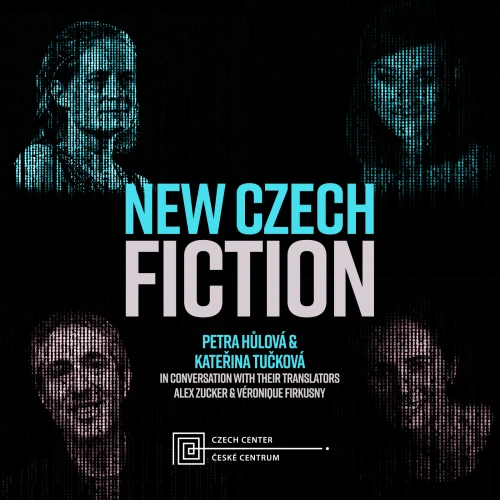
This week marks the U.S. publication of The Movement, Alex Zucker's translation of Petra Hůlová’s 2018 novel Stručné dějiny Hnutí, published by World Editions. The UK edition will be published on November 4. To learn about the book, you can join a live event on Zoom on Saturday, October 17, at 1 p.m. Eastern Time.
by Alex Zucker
The Movement, in a nutshell, is the story of a woman named Věra who works at an institute that reeducates men to value women for their internal qualities, rather than for their looks. In addition to her own work and the “treatment” that men receive, Věra also describes the reeducation that women are given at parallel facilities, in order to free them of their internalized misogyny, as well as the history of the women’s movement that overthrew the patriarchy and a few episodes in her own private life, focused mainly on her relationship with her mother.
Reviews so far have been extremely positive, with all of them citing Hůlová’s success at evoking discomfort as the reader learns the details of the methods used to reeducate women and men alike. As Kirkus wrote, “One part Animal Farm, one part The Handmaid’s Tale, one part A Clockwork Orange, and (maybe) one part Frankenstein, Czech writer Hůlová’s novel dismantles the patriarchy and replaces it with a terrifying alternative. [. . .] Hůlová’s provocative satire of a feminist future challenges and unsettles in equal parts.”
This is the third novel of Hůlová’s I’ve translated now, after All This Belongs to Me (Northwestern University Press, 2009) and Three Plastic Rooms (Jantar, 2018). Readers of her past works will recognize in The Movement one of her stylistic trademarks: the novel is narrated entirely from the viewpoint of the main character, with no third-person narration. Hůlová’s debut novel, All This Belongs to Me, was written in six chapters, narrated by five different women, and Three Plastic Rooms was narrated by a high-price prostitute with a glorious gift for snark, “in search of something resembling happiness and humanity in the gloating world of capitalism.”
Three novels by one author is certainly something to be happy for, given the difficulty of selling translations to U.S. publishers, and even more so for a language like Czech, with relatively less cultural oomph (and money) behind it than French, German, or Spanish. At the same time, it’s worth pointing out that the picture of Hůlová that English-speaking readers are privy to is far from complete.
Her 2004 novel Through Frosted Glass (Přes matný sklo), written in three parts—two narrated by a son and one by his mother—is much more melancholic and intimate in tone than the works that have been picked up by English-lanugage publishers; the title comes from the second part, narrated by the mother, and serves as a metaphor for the lack of communication and understanding between her and her son.
Also quite unlike her other works issued in English so far is Guardians of the Civic Good (Strážci občanského dobra). Published in Czech in 2010, from today’s viewpoint the novel seems almost prescient in its centering of a teenage girl in post–Velvet Revolution Prague who is dismayed at the deterioration in public goods that takes place with the installation of capitalism, and reacts by becoming a hardline pro-Communist. I say prescient because the novel depicts many of the phenomena and public sentiments that gave rise to the outbreak of fascism in the former East bloc.
Hůlová has several other novels besides those I’m highlighting here, but one other I’d like to draw attention to as significantly different from the writing Anglophone readers have seen so far is Daddy Thief (Zlodějka mýho táty), published in 2019, which looks at the impact of divorce on children, and in particular how kids can react when their parents take up with a new partner. The novel is narrated from the perspective of a 10-year-old boy, who, as it says here, hates his new siblings and his stepmother, who has “stolen” his dad. And not to mention Fox Eyes (Liščí oči), her latest book, for young adults.
In short, there is a rich vein of Hůlová out there still waiting to be mined, and I hope readers of The Movement will have the chance to read it all someday!
To close, if you’re looking for more information about The Movement, I highly recommend this interview with Hůlová conducted by Salwa Benaissa of Project Plume in late 2019. There are also several features I suggest on the World Editions website, including videos of both Hůlová and myself. And finally, you can find an excerpt of the novel itself at the online literary journal B O D Y.
Thanks for reading!
You can order the book The Movement here.