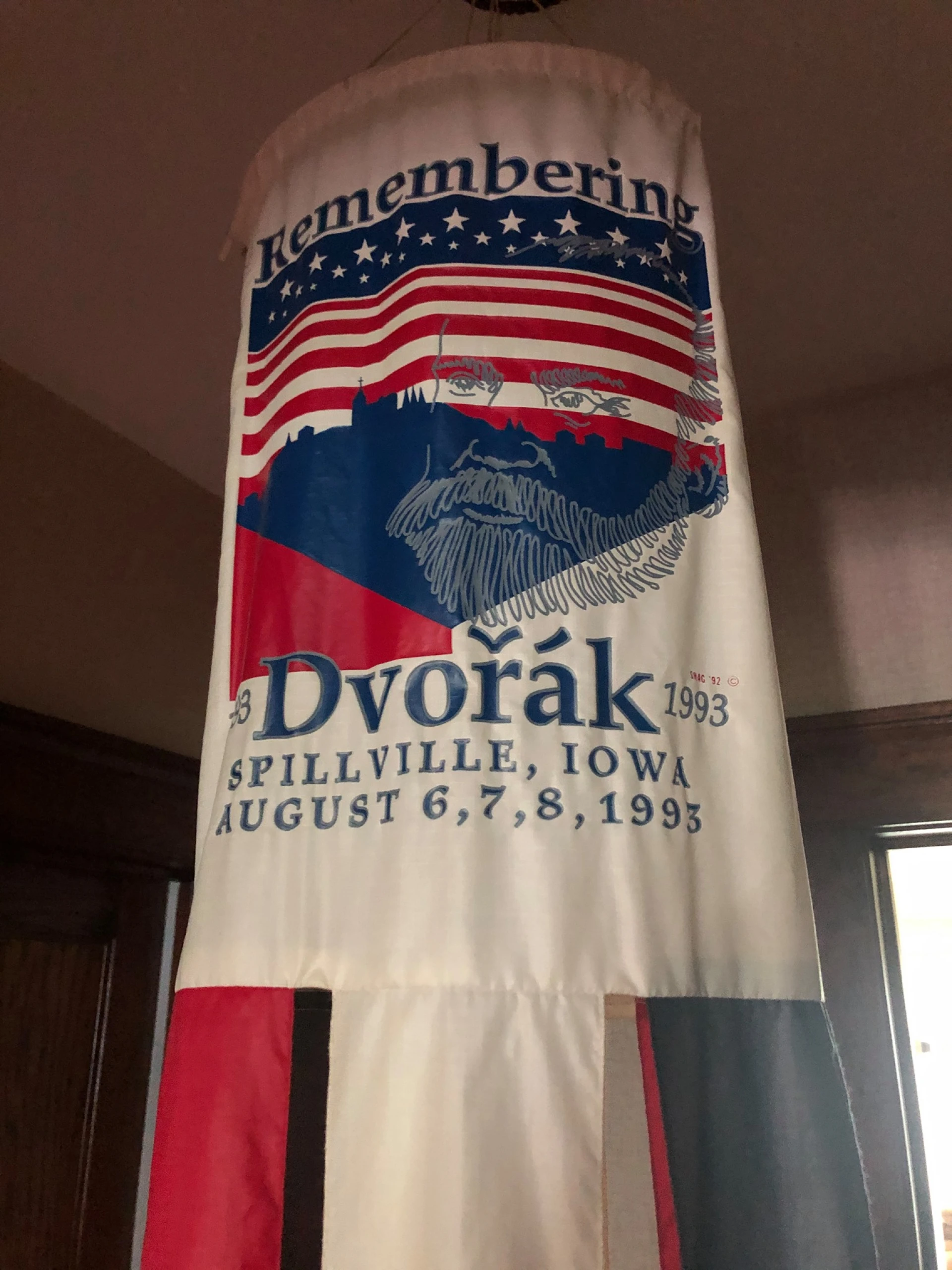
The hundred or so days in 1893 that composer Antonín Dvořák spent in Spillville, Iowa had a profound effect on the village.
The hundred or so days in 1893 that composer Antonín Dvořák spent in Spillville, Iowa had a profound effect on the village. After spending an extended period of time in America, Dvořák and his wife were finally reunited with their family, including their six children. What’s more, they finally found peace after their first rough year in the hectic city of New York, which they found stressful while Dvořák was serving as Director of the National Conservatory of Music of America. The family reached Iowa by train and then continued by wagon. Iowa reminded them of home, and Czech was still spoken in Spillville.
Cars with fancy trailers in tow now pull up in front of the small museum building, whose first floor was once inhabited by the Dvořáks – a telling sign that in Iowa, an otherwise somewhat dull tourist destination, Dvořák’s Spillville is a noteworthy place of interest.


Needless to say, it’s not the only attraction. In the same building on the High Street where the village established itself during the second half of the 19th century, there’s a very intriguing exhibit of carved musical clocks. These were made here a little later in the 20th century by Czech compatriots: the South Bohemian-born Bily brothers.
In a community founded by German expatriate Joseph Spielmann, South Bohemians formed the core of the Roman Catholic population here. Meanwhile, the local traders and bankers originated from Switzerland, and as they were not of the Catholic faith, they were not permitted to place their graves side by side with the Czechs in the Catholic cemetery.
I suppose you can say that in its heyday, many years after Dvořák, there were around 400 residents in Spillville who had access to a bank, two butcher shops, four pubs, general stores, and a hardware store, a blacksmith’s shop, and a Czech Catholic school (which still stands next to a new school and holds the title of “oldest Czech Catholic school in the USA”). Later additions included two gas stations and a wooden performance hall, which apparently made it into the Rock and Roll Hall of Fame in Cleveland on account of the many concerts that took place there.
The most precious gem of the town of Spillville can be found on top of a hill: the fairly large, yet still beautifully maintained Saint Wenceslaus Catholic Church made of granite stone. The church organ alone cost just under two thousand dollars, a lot of money at the time, but Czech compatriots managed to raise enough money for it in just one weekend. Having been played by Dvořák, the organ is now considered a priceless artifact.
The composer also played two upright pianos, which are now on display in the museum. The story goes that he wanted to hear what he composed here, which is why he recruited a small orchestra out of the family members of his US guide, Josef Jan Kovařík. And that’s how the world premiere of his American String Quartet in F major came to be held in Spillville.
Generally after sunrise, having made his long walk along the Turkey River and the Bohemian Creek Valley while the summer heat and humidity were still bearable, Dvořák arrived at the church at seven o’clock to play the organ during mass. Accustomed to quiet, morning prayer sessions, the local old ladies were very bemused to hear such beautiful sounds coming out of the organ at first, but soon enough, they found themselves singing along to Dvořák’s playing.
It’s a known fact that it was in Spillville where Dvořák composed his best American pieces – although his New World Symphony had already been finished by then. When the Indian medicine men brought their rituals and herbs into town, he would go and listen to them. Admittedly, most Czechs obtained their fertile land as a result of the forced displacement of American Indian tribes.
This undulating landscape of the Iowan countryside still holds onto its corn fields, pig farms, and cow grazing; there’s plenty of poultry; and full-grown trees line the rivers and creeks where Czech compatriots used to go fishing. There’s a discreet monument in a spot frequented by Dvořák where a stream meets a creek, but a statue of the Maestro in the village itself is still lacking. Just outside the settlement, the Czech National Cemetery is home to one of just two statues of Jan Hus in America.
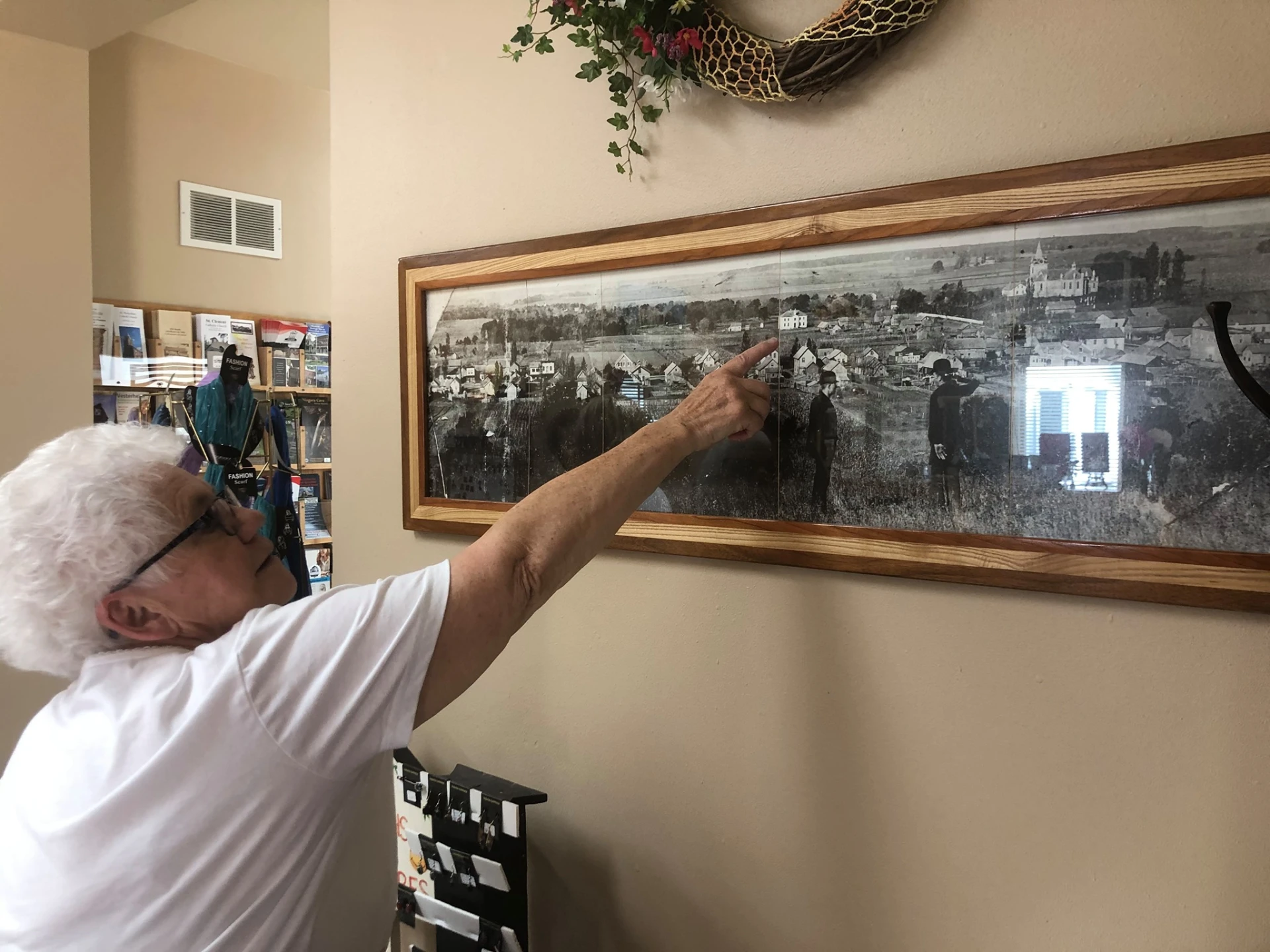
Czech musicians or the Czech Consul from Chicago turn up for an occasional visit, but it’s only natural that the majority of several thousand visitors who come here every year are senior Americans. They can cruise along the Dvorak Memorial Highway, take a tour of the house of the Kovaříks who famously invited the Dvořáks to Iowa, or see a mural in the small plaza, which shows what the place looked like during Dvořák’s times.
Spillville is worth a visit. And making sure that Dvořák is never forgotten here are two descendants of the original South Bohemian settlers: the Klimesh brothers Michael and Steven together with their Czech-speaking friend, who calls herself “Granny Eileen.”
As I was leaving the very hospitable town of Spillville, Largo from the “New World Symphony” was still playing in my head (for which I blame Jozef Ivaska, who sang the “Going Home” version with English lyrics for us in the church). And as I was thanking the brothers for their warm welcome and the local granny for her cake, I couldn’t help but wonder how much we owe it to this place. It was one of the reasons why I came – to understand and to work out how to change that. One idea for this coming Advent is already taking shape, and it involves a leading Czech opera singer and the Spillville church.
There’s something nostalgic about the few Czech flags flying from Spillville houses. Perhaps it’s rather fitting given the atmosphere that followed Antonín Dvořák for most his time in America. But this atmosphere should be coupled with music. For now, like in Dvořák’s times, the only singing that can be heard here comes from little songbirds: the Western tanagers, whose tunes were transcribed into scores by the most famous Czech composer in America.
Having received a fabulous welcome from the local Czechs throughout his journeys across the Midwest, Dvořák also visited Chicago where he appeared as a conductor at the World Exhibition.
He wrote to his friends:
"The whole family and I are in the state of Iowa, 1200 miles out West. A Czech settlement. We like it a lot. Despite the heat, we’ve spent a wonderful summer vacation here amongst the Czechs, and the children no longer complain about being homesick."
A special thanks to Veronika Vejvodová from the Museum of Music (@National Museum in Prague) for laying the groundwork for this article.